Showing posts with label Greek New Testament. Show all posts

Monday, April 13, 2009

Easter REDUX

imageYear by year, the truth behind the Christian celebration of Easter, the very heart of Christianity, the death and resurrection of Jesus Christ, is being progressively challenged. An Easter Redux is underway. Christians be warned!

Richard Dawkins, the scientist, author and campaigning atheist was asked, “What do you think happened to the body of Jesus, and how does that tally with the accounts of the resurrection?” Dawkins answered, “Presumably what happened to Jesus was what happens to all of us when we die. We decompose. Accounts of Jesus's resurrection and ascension are about as well-documented as Jack and the Beanstalk.” (The Independent)

image Surprisingly, Juan Garces, British Museum Library curator of the Codex Sinaiticus Project, who should know better adds support to this popular endeavour to rewrite the story behind Easter. When he was interviewed about “the world's oldest Bible,” this is what the Associated Press article claimed:

Handwritten in Greek more than 1,600 years ago -- it isn't exactly clear where -- the surviving 400 or so pages carry a version of the New Testament that has a few interesting differences from the Bible used by Christians today.

The Gospel of Mark ends abruptly after Jesus' disciples discover his empty tomb, for example. Mark's last line has them leaving in fear.

“It cuts out the post-resurrection stories,” said Juan Garces, “That's a very odd way of ending a Gospel.”

The problem here is that Garces was commenting on one gospel; the Bible has four and the other three definitely have all the post-resurrection accounts. Unfortunately, many people have run with Garces' words and understood him to be saying the world's oldest Bible does not document the resurrection. So The Times in London reports, “Mark’s last line has them leaving in fear and makes no mention of the Resurrection.” Or a couple days after the AP news release, Irma Arkus in the Hi-Sci-Fi blog writes,

One interesting fact about Codex Sinaiticus is that one of Christian cornerstone beliefs, the story of resurrection of Jesus is not mentioned. Instead, the story simply describes disciples finding an empty burial tomb, and leaving in fear. This implies that the “resurrection” was addended by later generations of followers.

Let's be clear with the facts. The Gospels of Matthew, Luke and John in the Codex all contain resurrection and post-resurrection accounts. And the claim that the Sinaiticus Gospel of Mark does not mention the resurrection is actually false. I affirm that the Gospel ends very abruptly in the Codex Sinaiticus and in many of the oldest manuscripts, and it does not have post-resurrection accounts, but to say that it “omits” the resurrection is ridiculous. The Codex Sinaiticus records Mark 16:6 as you'll see translated below, including the words, “ηγερθη ουκ εϲτιν ωδε” translated, “He has risen! He is not here,”; you can see for yourself at the Codex Sinaiticus website. It's shoddy scholarship and sloppy journalism to report that Mark (in Codex Sinaiticus) “makes no mention of the Resurrection.”image

Review Mark 16:1-8; this is TNIV Bible text, it is a translation following the Codex Sinaiticus and adds nothing not found in the Codex.

Mark 16:1 When the Sabbath was over, Mary Magdalene, Mary the mother of James, and Salome bought spices so that they might go to anoint Jesus' body. 2 Very early on the first day of the week, just after sunrise, they were on their way to the tomb 3 and they asked each other, “Who will roll the stone away from the entrance of the tomb?”
4 But when they looked up, they saw that the stone, which was very large, had been rolled away. 5 As they entered the tomb, they saw a young man dressed in a white robe sitting on the right side, and they were alarmed.
6 “Don't be alarmed,” he said. “You are looking for Jesus the Nazarene, who was crucified. He has risen! He is not here. See the place where they laid him. 7 But go, tell his disciples and Peter, 'He is going ahead of you into Galilee. There you will see him, just as he told you.' ”
8 Trembling and bewildered, the women went out and fled from the tomb. They said nothing to anyone, because they were afraid.

Most English translated Bibles in print today  do not end here, even though the vast majority of New Testament Greek scholars agree that the oldest and best manuscripts end here. The most popular English translation, the NIV, for example, has another 12 verses which gives Mark's Gospel a smoother ending, more like we find in Matthew and Luke. However, in a footnote the NIV points out, “The earliest manuscripts and some other ancient witnesses do not have Mark 16:9-20,” which means we know conclusively that Mark did not pen this ending. His writing ends at verse 8, as quoted above. Verses 9-20 represent an early attempt to finish the story, to give Mark an ending just like Matthew and Luke. We assume that Christians were uneasy with Mark's unique and abrupt ending. I am not uneasy with it. It is my favourite Easter Sunday reading. What can we make of the authentic ending of Mark's Gospel (16:1-8)?

Well, it's ironic, isn't it? “They said nothing to anyone.” All through Mark's gospel, people are told by Jesus not to tell anyone about what he has just done, but they immediately disobey and go tell everyone! For example, Jesus heals a man: Immediately the leprosy left him and he was cleansed. Jesus sent him away at once with a strong warning: “See that you don't tell this to anyone." Instead he went out and began to talk freely, spreading the news. (Mark 1:43b, 44a, 45a)

We may question why Jesus frequently gave this command, why he didn't want too many people discovering who he was, why he didn't want a frenzied mob constantly pursuing him. We do know that in chapter 9, Jesus tells his disciples not to tell anyone until he had been raised from the dead. It is the death and resurrection of Jesus which makes sense of everything else Jesus did. And now, in Mark chapter 16, that time has come! Jesus has been resurrected, but the women are silent! Jesus' repeated command “Say nothing to anyone” is almost exactly what Mark says of the women, “they said nothing to anyone.” It's Mark's final irony.

Looking back at this, we know now that they did get over their fear, and they did tell the other disciples, and they were so effective at telling the disciples and followers of Jesus that over 500 of them gathered together 40 days later and saw Jesus ascend into heaven just after giving his final words to go and tell everyone. Why didn’t Mark tell the rest of the story like Matthew, Luke and John?

Why end the story unresolved as Mark does?

In what I think is an incredibly great book on reading this gospel, Mark As Story, the authors say this about the ending:

It cries out for a resolution, cries out for the hope that someone will proclaim the good news. And who is left at the end of the story to do this?
Not Jesus.
Not the disciples.
Not the women who fled the grave.
Only the readers are left to complete the story! (pg. 143)

The rest of the story depends on us, not them. Mark 1:1 claimed that this gospel was the beginning of the good news about Jesus the Messiah. The rest of the story is up to you and me. Just as it did not end with the fear and failure of the women, so it does not end even with our fear and failure. Jesus does not give up on us when we fail him. That’s just the beginning of the gospel, there’s more to be told! He's not finished with any of us. This great news of life in Christ will continue to change people’s lives as we share it with them, in spite of our fears and failures.

It's our turn. The Easter Redux is underway and Richard Dawkins gets better press! It's up to you and me to talk about the Resurrected Jesus and the difference he's made in our lives. In thinking about Mark's abrupt ending and the passing of the gospel torch so to speak, I was inspired to think again by a Starbucks coffee cup when I read “The Way I See It”: image

There is no end to a story—it goes on indefinitely into eternity.  Every time a story is read, it’s alive and it’s different because the reader is different. 
                                              —Alice Hoffman

Related Sermon

The Rest of the Story
The ironic ending of Mark's Gospel (16:1-9) invites us to continue the story where Jesus’ first disciples left off. The gospel of Jesus Christ continues to transform lives as it is told.

Friday, October 10, 2008

Codex Sinaiticus: It's Greek to Me!

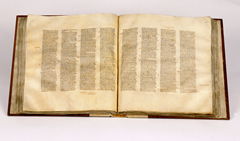
image Codex Sinaiticus, one of the oldest and most famous Bibles in existence, is indeed written in Greek. Friends of mine were alarmed by a BBC article which claimed that Codex Sinaiticus was "The Rival to the Bible." I too was quite alarmed by this article and its apparent aim to pose "some very uncomfortable questions" to "those who believe the Bible is the inerrant, unaltered word of God." I've chosen to use this blog entry to respond to some of these very uncomfortable questions which are nothing more than an attempt to sensationalize and distort the simple truth.

What's this about? Well, this is actually old news that the BBC is reporting. This summer a new website was launched which by next July will give full access to the full text of the Codex Sinaiticus, a fourth century Christian "bible", written in Greek, containing the New Testament, much of the Old Testament and a couple post-apostolic writings. Back in July they launched the site, giving access to high tech images of the Gospel of Mark and the book of Psalms. At that time CNN published the article, "World's oldest Bible goes online"; it's a better article than the BBC one as it is more factual, less distorting and less sensationalized.

There's quite a story behind the discovery of Codex Sinaiticus; it could almost be a script for Indiana Jones and the Keepers of An Amazing Bible. The discoverer, Constantine Tischendorf, somehow persuaded/extorted/tricked some Egyptians monks into giving him pieces of this Bible and they ended up in Russia, Germany & Britain. (You can read more about this exciting story in the Connected Photographer.) The website project will bring together high tech photos of all the pages and reunite the parts of this book, plus they are also transcribing and translating it, as well as giving us photos enabling us to see alterations and amendments made to the text. I think this is great news! I'm thrilled by the website and consider it to be quite a privilege to be able to actually view the pages of this very elegant, very important New Testament manuscript. Eight years ago I remember being in a Grand Rapids Bible bookstore with a colleague. We happened to find a book which was a transcribed copy of Codex Vaticanus, a manuscript equally as famous and important as Sinaiticus. My friend bought it for $120. I was quite jealous, but I knew there was no way my budget at that time would ever allow me to make such a purchase. Now, I'll have full access to Sinaiticus and not have to go broke buying a copied version. In preparing this article I discovered that The Center for the Study of New Testament Manuscripts already has photographs of Sinaiticus and many others online (just not at the high tech quality being offered by the new Codex Sinaiticus website).

So what about this BBC article was so alarming? They claimed that Codex Sinaiticus contains "anti-semitic writings" and many "discrepancies" with the Bible as we know it. Does the Codex contain "two extra books in the New Testament"? Well, the Codex includes two post-apostolic writings, The Shepherd of Hermas and The Epistle of Barnabas. I think the BBC artcle is stretching the evidence to say that the Codex includes these writings in the New Testament; no comment on the canonicity of these writings is being made. The Old Testament also "includes" the Apocryphal writings, as this was common in Greek versions of the Hebrew Old Testament. Books were hard to make in the fourth century, they wrote on every page, even if that meant adding writings!

I wouldn't agree with the BBC article that the Epistle of Barnabas is "full of anti-Semitic kindling ready to be lit." It is certainly opposed to any sort of Judaizing of the Christian faith, but you can check out the Wikipedia article for another perspective. The BBC supports their claim by quoting Barnabas, "His blood be upon us." I guess they didn't realize that the Gospel of Matthew actually has the Jews say, "His blood be on us and on our children!" (Matthew 27:25)

"The Codex - and other early manuscripts - do not mention the ascension of Jesus into heaven, and omit key references to the Resurrection..." This is the most incredible claim in the BBC article and it is false. Sinaiticus does not include the "longer ending" of Mark's Gospel, but ends at Mark 16:8, at which point you will find the NIV and most modern Bible translations noting that this is the end of Mark according to the earliest manuscripts. This means that Mark's gospel lacks an account of the ascension or any resurrection appearances, but it would still be incorrect to say that Mark "omits key references to the Resurrection." The Codex Sinaiticus records Mark 16:6 including the words, "ηγερθη ουκ εϲτιν ωδε" translated, "He has risen! He is not here,"; you can see for yourself at the website! The Codex Sinaiticus also includes Matthew, Luke and John's accounts of the resurrection, and Matthew & Luke's accounts of the ascension, as well as numerous other verses in the NT testifying the the resurrection of Jesus!

I find it hard to believe that Roger Bolton of the BBC actually interviewed Bart Ehrman or David Parker. The errors in this article are beyond unacceptable. Even a Greek NT hack like me devoting a couple hours to research can show how mistaken the claims in this article are. I was surprised when Bolton claimed that "other differences concern how Jesus behaved." Really? "In one passage of the Codex, Jesus is said to be 'angry' as he healed a leper, whereas the modern text records him as healing with 'compassion.'" It's not only our modern English text, but almost all of the Greek manuscripts we have of Mark 1:41 which refer to Jesus' compassion, not anger. But here's the kicker: it is NOT Codex Sinaiticus which refers to Jesus being angry, it's actually Codex Bezae of the 5th/6th century!!! Sinaiticus clearly says και ϲπλαγχνιϲθειϲ, translated "Filled with compassion...," but you don't have to take my word for it, check it out: the photo of Sinaiticus' Mark 1:41 is online.

What about "the story of the woman taken in adultery"? It is missing from the Codex as is claimed by the BBC article, but I would emphasize that John 7:53 - 8:11 is not in our earliest NT manuscripts and this is well noted in the NIV and other modern translations. The story is best understood as a Christian tradition appended to John's Gospel in later manuscripts.

Jesus does not say, "Father forgive them for they know not what they do" in the Codex according to the BBC article. This is not exactly correct. These words of Luke 23:34a were originally in the Sinaiticus manuscript. Then someone editing the manuscript erased them, but then another editor put them back in! One of the amazing things being done by the Codex Sinaiticus Project is to take photos which will help reveal these layers of editing with greater clarity.

I've just shown that the Codex Sinaiticus does not make any of the changes or omissions as claimed by the BBC article. Now, I'd like to comment on the article's claim that Codex Sinaiticus is "the rival to the Bible." Not true. I would be quite willing to say that Codex Sinaiticus IS the Bible, an early 4th century Bible, copied by hand, and therefore subject to normal human copying mistakes. I could mention some of them, but rest assured, none of them are nearly as BIG as the ones falsely presented in the article! In my second year of Greek studies, I remember being taught that the pioneers of NT textual criticism, Westcott and Hort said that, 'When Codex Sinaiticus and Codex Vaticanus agree (they have the same words exactly), you have the original text.' We have found many more NT manuscripts since then, but their observation still holds some weight today.

The publication of Codex Sinaiticus on the web should not give any Christian today any reason to be fearful or concerned that their faith is going to be undermined. If the Bible you read is the NIV or NLT or TNIV or or NET or NASB or NRSV, you've already been reading from Codex Sinaiticus! It has had an influence on basically every English translation of the Bible to come after the King James Version. Sure, "when the different parts" of the Codex Sinaiticus "are digitally united next year in a £1m project, anyone will be able to compare and contrast the Codex and the modern Bible," but don't expect to find anything earth shattering. We've been comparing and contrasting Sinaiticus and another 5000+ Greek NT manuscripts for quite a long time now! Textual criticism is "the study of the manuscript evidence for a written work for which the original is no longer extant, with the intent to discern the original text" (Matthew DeMoss). I agree with other NT scholars who claim that we have the NT today to be 99.5% pure original. Not to shock you, but that's actually better than many of the works of Shakespeare!

BBC 0, CNN 1. In closing, few explain it as well as Josh McDowell. Here's part of a recent interview he gave:

Do we have any of the original New Testament documents?

McDowell: If we did they would be beyond priceless. What we have is early manuscript copies of the originals.

Then how do we know for sure what was in the original documents?

McDowell: To discover the accuracy of copying for the New Testament material and see whether or not it has been “changed,” you have to look at two factors: One, the number of manuscripts existing today; and two, the time period between the original document and the earliest manuscripts still in existence today. The more manuscripts we have and the closer the manuscripts are to the original, the more we are able to determine where copyist errors happened and which copies reflect the original.

For example, the book Natural History, written by Pliny Secundus, has 7 manuscript copies with a 750-year gap between the earliest copy and the original text. The number two book in all of history in manuscript authority is The Iliad, written by Homer, which has 643 copies with a 400-year gap.

Now this is a little startling: the New Testament has currently 24,970 manuscript copies, completely towering over all other works of antiquity. In addition, we have one fragment of the New Testament (NT) with only a 50-year gap from the original, whole books with only a 100-year gap, and the whole NT with only a 225-250-year gap. I don’t think there is any question from all of these early copies that we know exactly what the original documents said.

Friday, April 4, 2008

Fresh Strawberries

strawberryfreshIt is good that the New Testament has been translated into so many languages.... But there is so much that cannot be translated. It is not possible to reproduce the delicate turns of thought, the nuances of language, in translation. The freshness of the strawberry cannot be preserved in any extract. This is inevitable.

—A.T. Robertson

This morning while eating my strawberry yogurt, I remembered this insight from A.T. Robertson, a great New Testament Greek scholar from a generation or two ago. I have the quote written in the front of my first Greek NT. He was comparing the fresh sweet taste of reading the New Testament in Greek with the preservative-rich strawberry jam tasted when reading English translations. While that inspires me to study my Greek and Hebrew more diligently, Robertson's vivid contrast can also be applied to Christians today who spend more time reading about the Bible than reading the Bible.

Yesterday as he left, a friend mentioned he was off to read some book by some author for his devotional time before going to bed. Certainly The Prayer of Jabez and The Purpose-Driven Life were for a while used by many Christians for their devotional times, in place of the Bible. I am currently reading:

  • The Challenge of Jesus by N.T. Wright (wow!)
  • Love is the Killer App (while not explicitly Christians, I feel that Tim Sanders has something significant to say about how we live out Jesus' love command in our day)
  • Timothy Findley's Not Wanted on the Voyage (very strange re-telling of the Noah's Ark story, but it won a CBC Canada Reads award)
  • a Macleans' cover article about Jesus having an identity crisis

Next to that list it now seems like a footnote to say that I'm also reading the Bible (Jeremiah, Matthew and 1 Peter). Re-applying his insight,strawberrypreserve I suspect A.T. Robertson would say to us, Do you spend more time reading about God's Word than you do in reading God's Word? Don't you understand that the freshness of the strawberry cannot be preserved in any extract? Taste the freshness of the strawberry again for the first time...

If I only eat strawberry yogurt, I'm missing the freshness, sweetness and wholeness of strawberries. An Australian pastor trying to do for his church what Eugene Peterson did for his American church, has translated Psalm 119:103 like this,

Your words taste so sweet on my tongue,
they are like strawberries and cream!

Recommended Bible Translations

for personal study: NET Bible (New English Translation, online!)

The extensive translators' notes make this an amazing study Bible. Even without knowledge of Greek & Hebrew, you'll be alerted to the issues that the translators dealt with. Pay attention, especially, to the extensive "syntax notes" as these give you good insight into the arguments of the Biblical authors. This is a far better choice than the NASB as you get actual commentary on the Greek (or Hebrew) text, rather than reading a wooden, so-called “literal” English translation.strawberry2

for personal and public reading: Today's New International Version (TNIV)

This is my choice for best all-around use Bible as it is clearly contemporary and yet very faithful to the Greek and Hebrew texts. Since so many carry the NIV, the TNIV is a great choice for public reading as it is close in text but makes many important corrections and good improvements, including the use of gender-inclusive language for people, when appropriate. Coming in 2011, there will be a new revised and updated NIV which I highly recommend.

for personal reading: New Living Translation (NLT)

The freshness of this translation is rewarding and the quality of scholarship behind this work is impressive. Read the Bible as if for the first time all over again.

and for that Australian version I mentioned above see: laughingbird.net

Here, for example, is Mark 9:33–35

They arrived home in Capernaum and after settling back into the house, Jesus hit them with a question: “You blokes sounded like you were having a bit of a barney back there on the road. What was it all about?”
........The silence was deafening! None of them were willing to own up, because they had been arguing over superiority — which of them was the greatest. Jesus sat down and called the twelve to gather round. He said to them, “Whoever wants to be number one must take a place at the bottom as the servant of everyone else.”

LinkWithin

Related Posts with Thumbnails